
This series contains 24 animated historical maps. For a preview, please consult the maps below:
▶ The Congress of Vienna 1814 - 1815
▶ Outbreak of the First World War
Subscribe

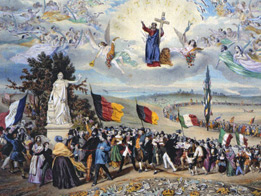
Europe and nations, 1815-1914
Throughout the 19th century, there was growing interest in establishing new national identities, which had a drastic impact on the map of Europe. These transformations also highlighted the failure of a certain ’European order’ which led to the outbreak of the First World War.

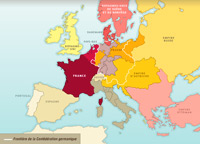
The Congress of Vienna 1814 - 1815
Complete video
During the Congress of Vienna, the four great victors (Austria, France, Russia and the United Kingdom) redrew the map of Europe and attempted to put an end to the period heralded by the French Revolution.
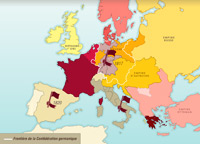
Uprisings after the Congress of Vienna
Video extract
The political map of Europe drawn up during the Congress of Vienna is quickly contested, despite the efforts of the European powers, working together as the Holy Alliance, to avoid any challenge to the established order.
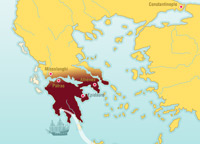
Independence of Greece
Video extract
In 1821, the Greeks launched a war of independence against the Ottoman Empire.
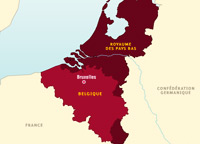
Independence of Belgium
Video extract
The Kingdom of The Netherlands, as constituted by the Congress of Vienna, broke apart in 1830.
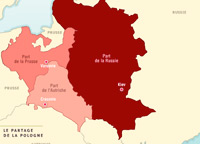
The Polish Question
Video extract
This map describes the major phases of the dismantlement of Poland, which had been a powerful country during the 15th and 16th centuries.
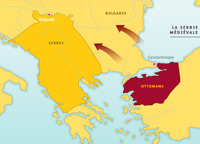
Serbian Autonomy
Video extract
This map explores key dates in the history of the Serbian Kinom from the 12th century onwards.
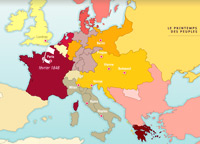
Revolutions of 1848
Video extract
After the failures that occurred during the preceding period, European peoples wished to obtain greater political freedom and to enforce recognition of the principle of nationalities. Therefore, protests break out at the beginning of 1848.
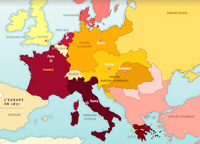
The Triumph of Nationalities 1850-1871
Video extract
In 1848, the Spring of Nations ended with the failure of liberal forces in Europe. Meanwhile unification of Germany and Italy marked the triumph of nationality.
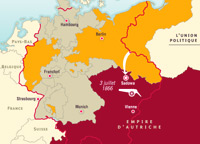
Unification of Germany
Video extract
Bismarck forged German unity by launching three major wars against Denmark, Austria, and France.
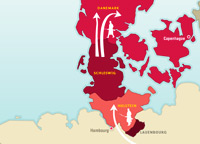
The Affair of the Duchies
Video extract
Danish and German populations lived side by side in the three duchies of Schleswig, Holstein and Lauenburg.
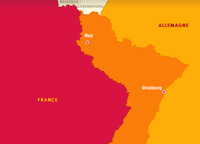
Annexation of Alsace and Lorraine
Video extract
The annexation of these two regions illustrates how France and Germany interpreted the concept of the ‘nation’.
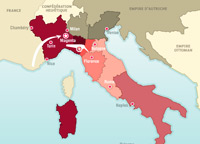
Unification of Italy
Video extract
With help from France, Cavour built up Italian unity using the Kingdom of Piedmont & Sardinia as its starting point.
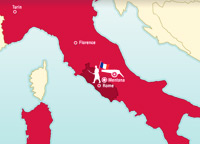
The Roman Question
Video extract
For Italian patriots, Rome was the obvious capital of unified Italy, but the Pope refused to give up territory belonging to the heritage of Saint Peter.
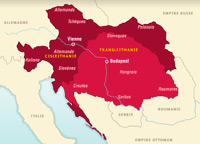
Austria-Hungary 1867
Video extract
Excluded from the movement of German unification, the Austrian Empire was transformed into a bi-national state: Austria-Hungary.
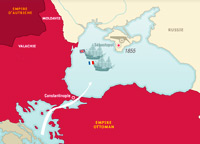
The Crimean War
Video extract
France and England become allies in order to combat Russian control of the Straits.
Towards the Clash of Nations 1871-1914
Video extract
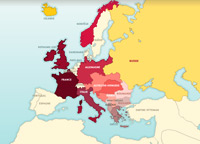
The ‘European Order’, promoted by the Congress of Vienna, was replaced by a system of alliances which divided Europe into two hostile blocs.
Independence of the Balkan Peoples
Video extract
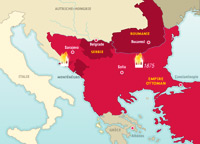
From 1875, the situation in the Balkans was complicated by a series of crises. In 1914, the Ottoman Empire’s European territory was reduced to Eastern Thrace.
The Irish Question
Video extract
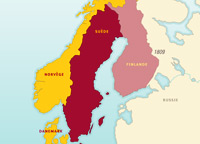
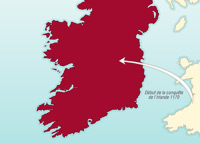
The outbreak of the First World War blocked the Irish Catholic's motion for independence.
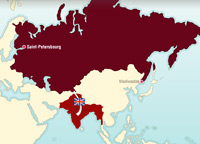
Expansion of the Russian Empire after 1815
Video extract
The Russian Empire’s plans for expansion in the Far East were blocked by Japan and by the European powers in the Straits.
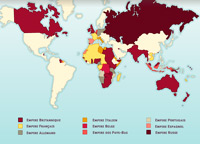
Europe’s Colonial Empires in 1914
Video extract
In 1914, the colonial empires established by the European Powers spread relentlessly across the globe.
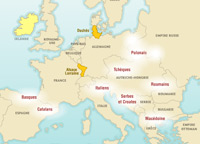
National Minorities in 1914
Video extract
Around 1914, a number of populations were linked by a common language, religion or history and sought to obtain their independence or create their nation.
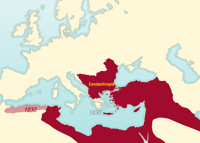
The Ottoman Empire: Expansion and Retreat
Video extract
This map illustrates several key dates in the history of the Ottoman Empire since the 14th century.
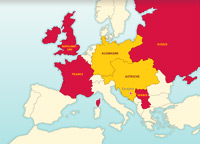
Outbreak of the First World War
Complete video
In 1914, the alliances between countries bring Europe to the brink of war.